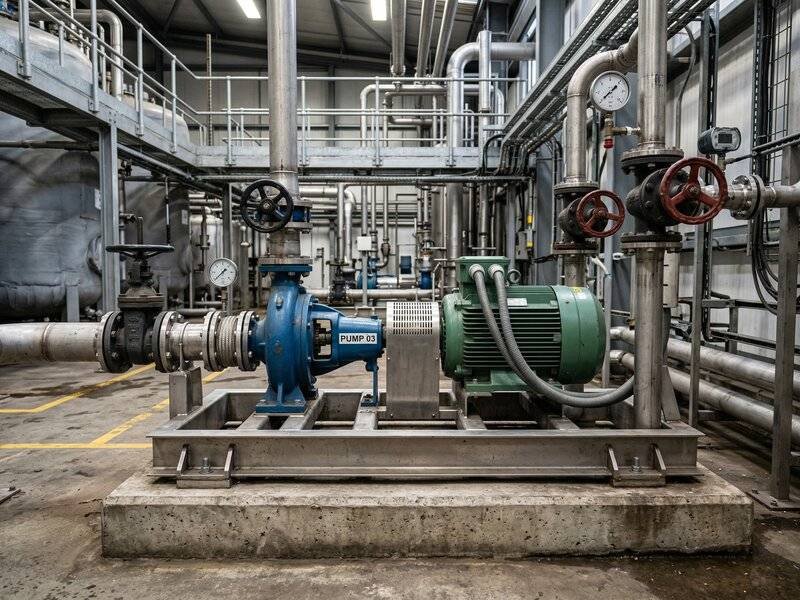
Pumps
Pumps for water and wastewater treatment: centrifugal, submersible, self-priming, high-pressure RO feed and sludge pumps from KSB, Grundfos and others.
Technical Specifications
| Pump Types | Centrifugal · submersible · self-priming · high-pressure · peristaltic · mono |
|---|---|
| Applications | Clean water · wastewater · sludge · chemical dosing · RO feed |
| Flow Range | 0.1 – 10,000 m³/h |
| Pressure Range | 0.1 – 250 bar |
| Motor Power | 0.09 – 2,000 kW |
| Materials | Cast iron · SS 304 · SS 316L · duplex SS · PP · PVDF |
| Seal Types | Mechanical seal · expeller · mag-drive |
| Energy Efficiency | IE3 / IE4 motor class (Grundfos MGE) |
| VFD Compatibility | All pumps compatible with variable speed drives |
| Standards | CE · ATEX · ISO 9908 · ISO 5199 |
Key Features
- Grundfos MGE pumps with integrated variable speed drive save 30–50% energy
- Submersible sewage pumps with vortex impeller handle up to 100 mm solids
- High-pressure multistage pumps (up to 250 bar) for SWRO desalination service
- Mono (progressive cavity) pumps for viscous sludge transfer without dilution
- All pumps supplied with motor performance certificates and hydraulic test reports
- Key spares (impellers, mechanical seals) from our warehouse in Neuss – availability confirmed on request
Applications
- RO high-pressure feed pumps
- Wastewater transfer and lift pumping
- Sludge recirculation and waste sludge pumping
- Chemical transfer and dosing
- Clean water distribution
- Industrial process fluid transfer
Product Overview
CM Aquatechnik supplies a complete pump selection for all water and wastewater treatment applications — centrifugal, submersible drainage, submersible sewage, high-pressure RO feed, self-priming, chemical dosing, and sludge pumps. We work with many leading pump manufacturers, including KSB, Grundfos, Lowara, Tsurumi and Sulzer, to ensure the right pump for every duty.
Our pump engineers size and select pumps based on hydraulic design, duty cycle, fluid characteristics, and energy efficiency requirements. Full pump performance curves, materials schedules, and ATEX options available for all applications.
Filter press feed pumps: for sludge dewatering we supply progressive cavity and centrifugal feed pumps matched to the press – see our filter press page for how the right feed pump is selected.
Which pump for which duty
| Duty | Usual pump type |
|---|---|
| Wells and raw water intake | Submersible borehole pump or dry-installed centrifugal pump |
| Pressure boosting and filter feed | Vertical multistage or end-suction centrifugal pump |
| High-pressure feed for reverse osmosis | Multistage centrifugal pump; for seawater with an energy recovery device |
| Wastewater and sewage | Submersible pump with vortex or channel impeller |
| Sludge | Progressive cavity or rotary lobe pump |
| Filter press feed | Filter press feed pumps up to 16 bar |
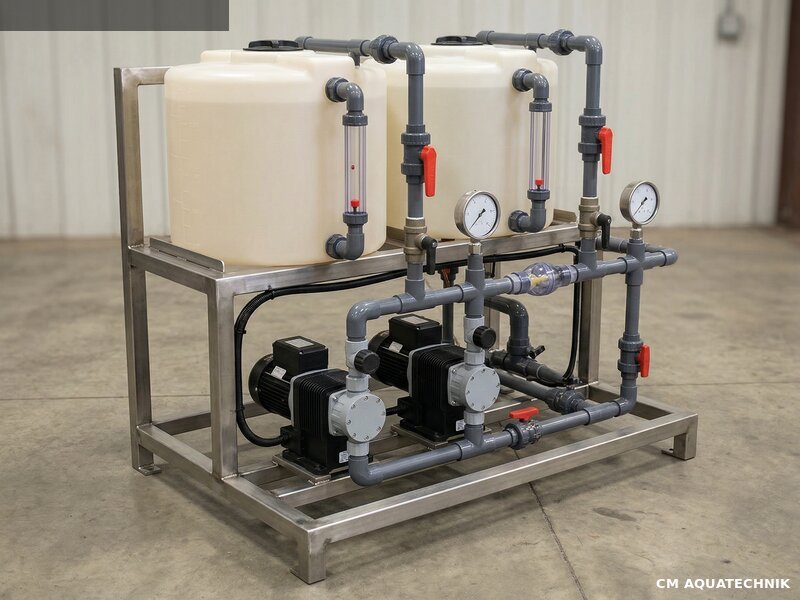
| Chemical dosing | Diaphragm metering pump |
| Filter backwash | End-suction centrifugal pump with a high flow at low head |
Selection data
- Duty point — flow and head, with the minimum and maximum operating conditions.
- Suction side — the available NPSH, suction lift or flooded suction.
- Liquid — solids content and size, viscosity, temperature and chloride content, which decide between cast iron, stainless steel, duplex and plastic.
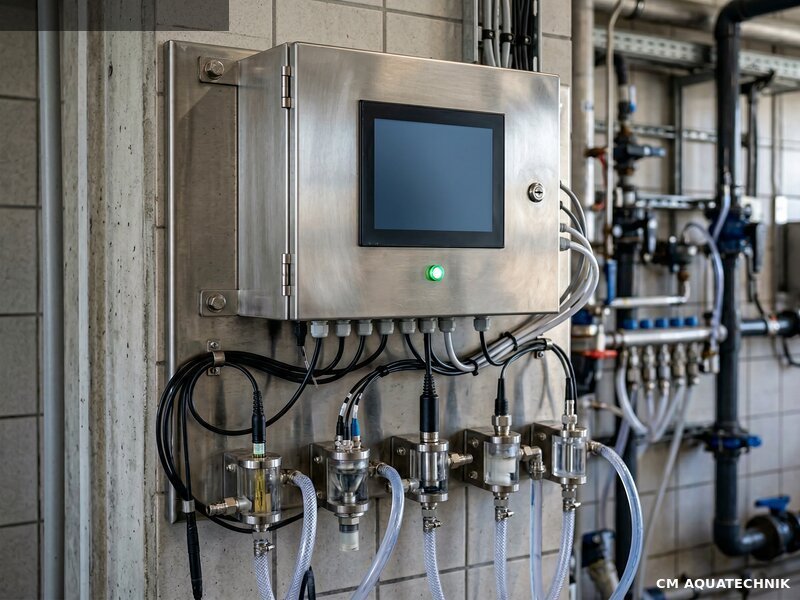
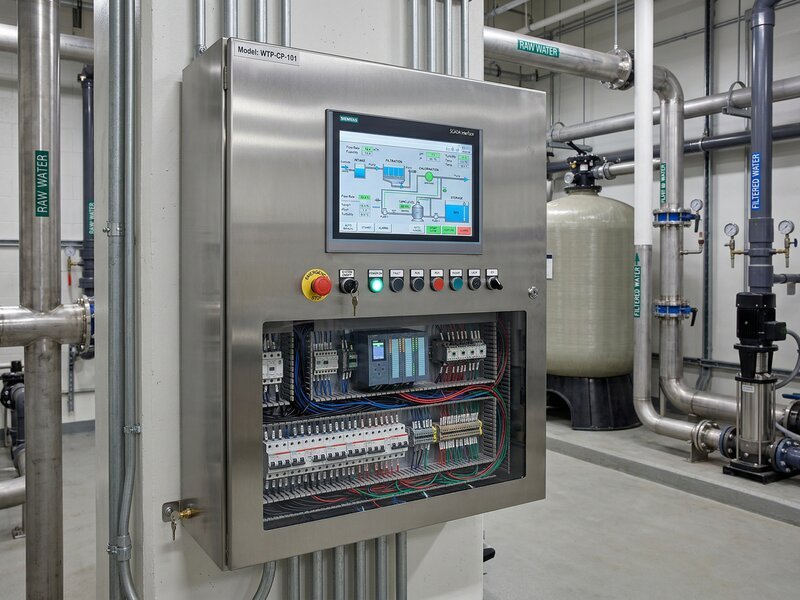
- Control — fixed speed or a frequency converter with pressure, flow or level control.
- Installation — dry or submerged, horizontal or vertical, the space available and the pipe connections.
- Standards — motor efficiency class IE3 or IE4, acceptance test to ISO 9906, dimensions to EN 733 or ISO 2858 where interchangeability matters.
What determines the cost
- Energy — for a pump that runs continuously, energy is by far the largest part of the life-cycle cost. A pump sized for the real duty point and a frequency converter pay back quickly.
- Material — duplex and special alloys for seawater and aggressive media cost several times as much as cast iron.
- Seals and bearings — the mechanical seal design decides the service intervals.
- Spare parts — availability of wear parts for the planned service life. We supply pumps from KSB and other manufacturers and confirm stock in Neuss and lead times with each quotation.
Frequently asked questions
How do you select the right pump for my application?
Our pump engineers size and select pumps based on the hydraulic design, duty cycle, fluid characteristics and energy efficiency requirements. Full performance curves and materials schedules are provided so that you can verify the duty point and the suitability of the materials for your fluid.
Which pump types are suitable for wastewater and sludge?
Submersible sewage pumps with vortex impellers handle solids of up to 100 mm, while mono (progressive cavity) pumps transfer viscous sludge without dilution. For clean water, RO feed and chemical dosing, centrifugal, multistage high-pressure and peristaltic pumps are used.
How can pump energy consumption be reduced?
All our pumps are compatible with variable speed drives, which match pump output to the actual demand instead of throttling the flow. Grundfos MGE pumps with an integrated variable speed drive and IE3/IE4 motors can save 30–50% energy.
What information do you need for a quotation?
Please provide the fluid and its properties (solids content, viscosity, temperature, chemical composition), the required flow and head or pressure, the suction conditions, the duty cycle, the installation type (dry or submersible) and any ATEX requirements. Send us your requirements and we will prepare a proposal within 48 hours.
Last updated: · Technical data are typical values; the final design follows your water analysis and project data. Stock availability in Neuss and lead times are confirmed with the quotation.